Halfway - Couples Budgeting App
About the project
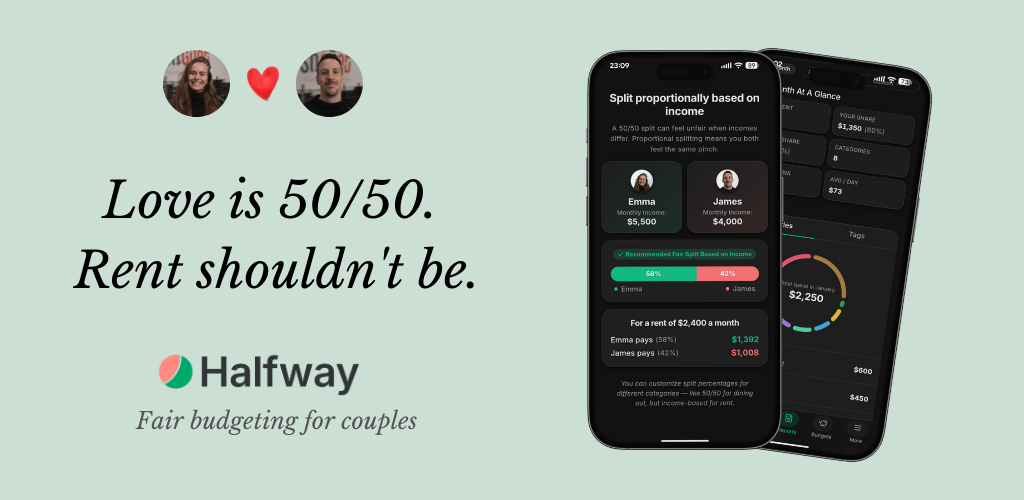
My wife and I frequently found ourselves arguing about money despite our efforts to split expenses evenly. I earned significantly more than she did, and while a 50/50 split felt equal, it created an unfair dynamic. She was often stressed about rent while I felt comfortable, prompting us to realize that traditional expense splitting doesn’t work for couples with different incomes. This inspired me to build Halfway: a solution for proportional expense splitting based on actual earnings. Now, couples can contribute fairly instead of equally, reducing financial stress and relationship tension. Halfway helps couples manage their expenses fairly based on income. Instead of a rigid 50/50 split that can breed resentment, we calculate proportional contributions. For instance, if one person earns 60% of the household income, they pay 60% of shared expenses. Couples can track groceries, rent, utilities, and bills together, see who owes what in real-time, and settle payments seamlessly through Venmo or Zelle. It’s budgeting designed just for couples with differing salaries. The feedback we've received from our early users has been fantastic. One couple shared, "Finally, a budget app that understands income differences. We’ve shifted to a 65/35 split, and both of us feel better about it." Another user remarked, "The settlement feature alone is worth it. No more awkward money conversations!" Our organic growth has been strong, particularly among couples who have just moved in together or gotten engaged—precisely the audience that needs this most. We currently have over 100 users and 80 app downloads in our beta launch. The biggest wow moment for me while building on Floot was how effortlessly I could deploy a production-ready app for both mobile and desktop. I managed to deliver Halfway in mere weeks instead of months. The seamless integration of bank connections through Plaid, real-time syncing between partners, and a clean UI across devices allowed me to concentrate on solving the core problem rather than dealing with technical infrastructure.