How to Calculate Your Break-Even Point: Step-by-Step Guide

How to Calculate Your Break-Even Point: Step-by-Step Guide
You have a business idea. You know your startup costs. You know roughly what you'll charge customers. But here's the question that keeps you up at night: how many sales do you need before you actually make money?
That number is your break-even point.
Understanding break-even is not optional. It's the difference between launching a sustainable business and running out of cash before you gain traction. This guide walks you through the concept, shows you the math with a real example, and gives you a tool to calculate it instantly.
What Is a Break-Even Point?
Your break-even point is the moment when your total revenue equals your total costs. At this point, you're not making profit yet. You're also not losing money. You're breaking even.
Once you pass your break-even point, every additional sale becomes profit.
Knowing this number helps you:
- Set realistic sales targets for your first year
- Understand how long you can operate before needing profitability
- Make decisions about pricing and cost management
- Communicate financial viability to investors and lenders
- Identify which business models are actually viable
The Three Numbers You Need to Know
Calculating break-even requires understanding three financial concepts. Let's define each one, then we'll use them in a real example.
Fixed Costs
Fixed costs are expenses that stay the same every month, regardless of how many products you sell or services you deliver.
These costs don't change based on your sales volume. You pay them whether you sell one unit or one thousand units.
Examples of fixed costs:
- Rent or lease payments
- Salaries for full-time employees
- Insurance premiums
- Software subscriptions
- Equipment depreciation
- Loan payments
Variable Costs
Variable costs are expenses that change based on how much you produce or sell.
The more units you sell, the higher your variable costs. If you sell nothing, you have no variable costs.
Examples of variable costs:
- Raw materials or ingredients
- Packaging
- Shipping and delivery
- Sales commissions
- Credit card processing fees
- Labor (if you pay per hour based on production)
Contribution Margin
Contribution margin is the amount of revenue left over after you subtract variable costs from each sale.
This is the money available to cover your fixed costs and eventually generate profit.
The formula is simple:
Contribution Margin per Unit = Price per Unit minus Variable Cost per Unit
If you sell a product for $20 and it costs $8 to make, your contribution margin is $12 per unit. That $12 goes toward paying your fixed costs.
Real Example: Opening a Coffee Shop
Let's say you want to open a coffee shop. You've researched the numbers and here's what you found:
Fixed Costs (Monthly)
- Rent: $3,000
- Employee salaries: $5,000
- Utilities: $800
- Insurance: $500
- Equipment maintenance: $200
- Miscellaneous: $500
Total Fixed Costs: $10,000 per month
Variable Costs Per Cup of Coffee
- Coffee beans and supplies: $0.75
- Cup and lid: $0.25
- Milk and extras: $0.50
Total Variable Cost per Cup: $1.50
Price Per Cup
You've decided to charge $5.50 per cup of coffee.
Contribution Margin Per Cup
$5.50 (price) minus $1.50 (variable cost) equals $4.00 per cup
Each cup of coffee you sell contributes $4.00 toward covering your fixed costs.
The Break-Even Calculation
Now we can calculate your break-even point.
Break-Even Point (in units) = Total Fixed Costs divided by Contribution Margin per Unit
Break-Even Point = $10,000 divided by $4.00 = 2,500 cups of coffee per month
This means you need to sell 2,500 cups of coffee every month just to break even. You're not making profit yet. You're covering all your costs.
Break-Even Point (in revenue) = 2,500 cups multiplied by $5.50 = $13,750 per month
You need to generate $13,750 in monthly revenue to break even.
What Happens After Break-Even?
Once you sell your 2,501st cup of coffee, you start making profit.
Each additional cup generates $4.00 in profit (the contribution margin). If you sell 3,000 cups in a month instead of 2,500, you make an extra $2,000 in profit.
If you sell 4,000 cups, you make an extra $6,000 in profit.
This is why understanding break-even matters. It shows you the path from startup costs to profitability.
How to Lower Your Break-Even Point
The lower your break-even point, the faster you become profitable. You have three levers:
Increase Your Price
If you raise the price from $5.50 to $6.00, your contribution margin increases from $4.00 to $4.50 per cup. Your break-even point drops to 2,222 cups per month.
Reduce Variable Costs
If you negotiate better rates with your coffee supplier and reduce variable costs from $1.50 to $1.25 per cup, your contribution margin increases to $4.25. Your break-even point drops to 2,353 cups per month.
Reduce Fixed Costs
If you negotiate lower rent or reduce staffing, you lower fixed costs. If you reduce monthly fixed costs to $9,000, your break-even point drops to 2,250 cups per month.
Most successful businesses use a combination of all three strategies.
Calculate Your Break-Even Point Instantly
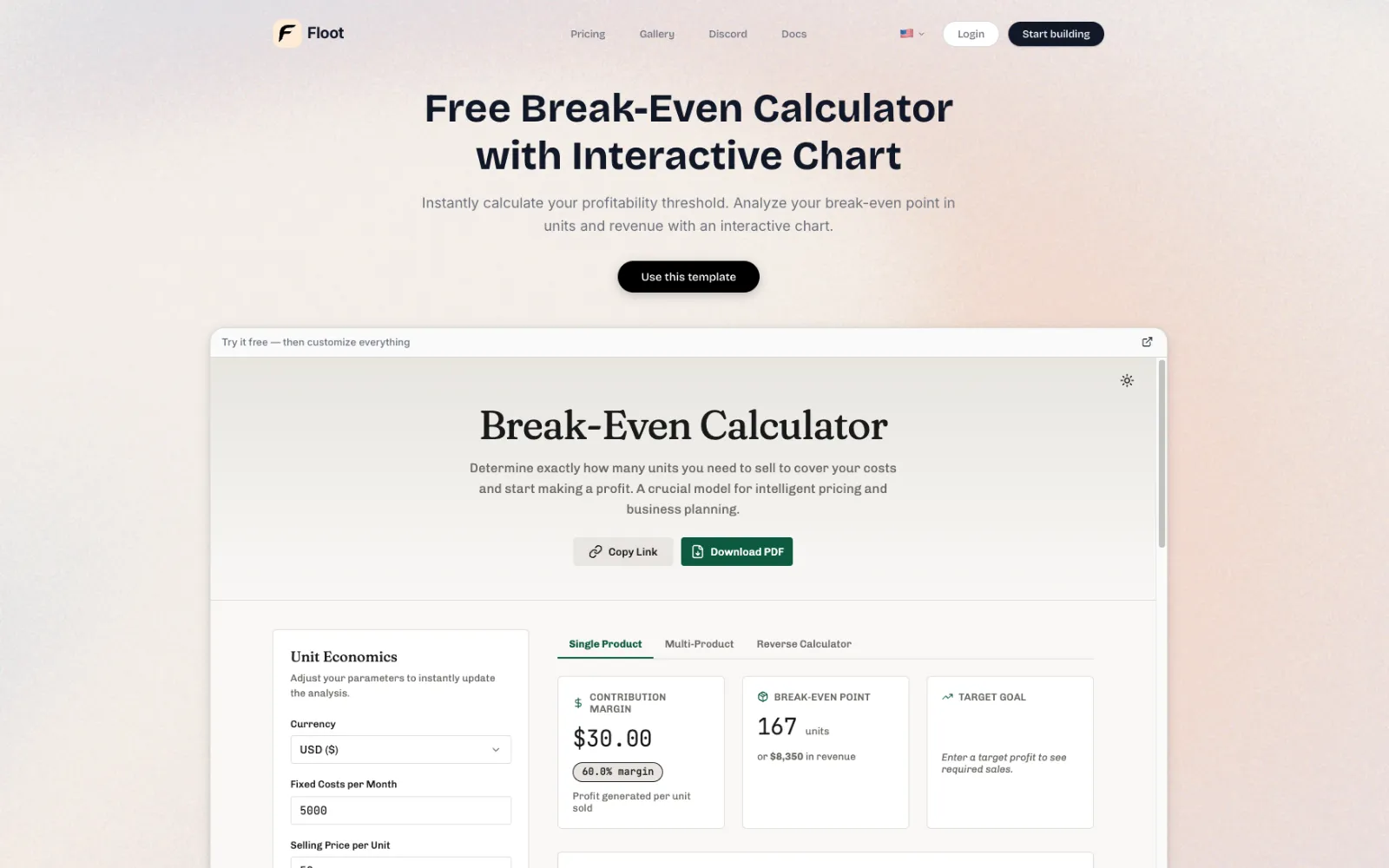
Doing this math manually is tedious and error-prone. That's why we built an interactive break-even calculator.
Instead of doing calculations on paper or in a spreadsheet, you can enter your numbers and instantly see:
- Your exact break-even point in units
- Your exact break-even point in revenue
- A visual chart showing the relationship between costs and revenue
- What happens if you adjust your price, variable costs, or fixed costs
You can test different scenarios in seconds. What if you raise prices by 10 percent? What if you reduce variable costs? What if you negotiate lower rent?
The calculator shows you the impact immediately.
Access the Break-Even Calculator
Use the interactive calculator to run your own numbers: https://floot.com/tools/break-even-calculator
Enter your fixed costs, variable costs per unit, and price per unit. The calculator does the rest.
Why This Matters for Your Business
Break-even analysis is not just a financial exercise. It's a strategic tool.
When you know your break-even point, you can:
- Set realistic first-year revenue targets
- Understand how much runway you have before you need profitability
- Make pricing decisions based on data, not guesses
- Identify which products or services are actually profitable
- Decide whether to pivot, scale, or shut down
- Communicate financial viability to investors
Many businesses fail not because the idea is bad, but because the founder never calculated whether the unit economics actually work. Break-even analysis prevents this mistake.
Final Thoughts
Break-even is the foundation of business math. It's the first question every founder should answer: how many sales do I need to survive?
Once you know that number, you can build a plan to exceed it.
Start with the interactive calculator. Run your numbers. See what your break-even point actually is. Then decide if the path to profitability is realistic for your business.