How to Write an Engagement Letter for Your Accounting Firm

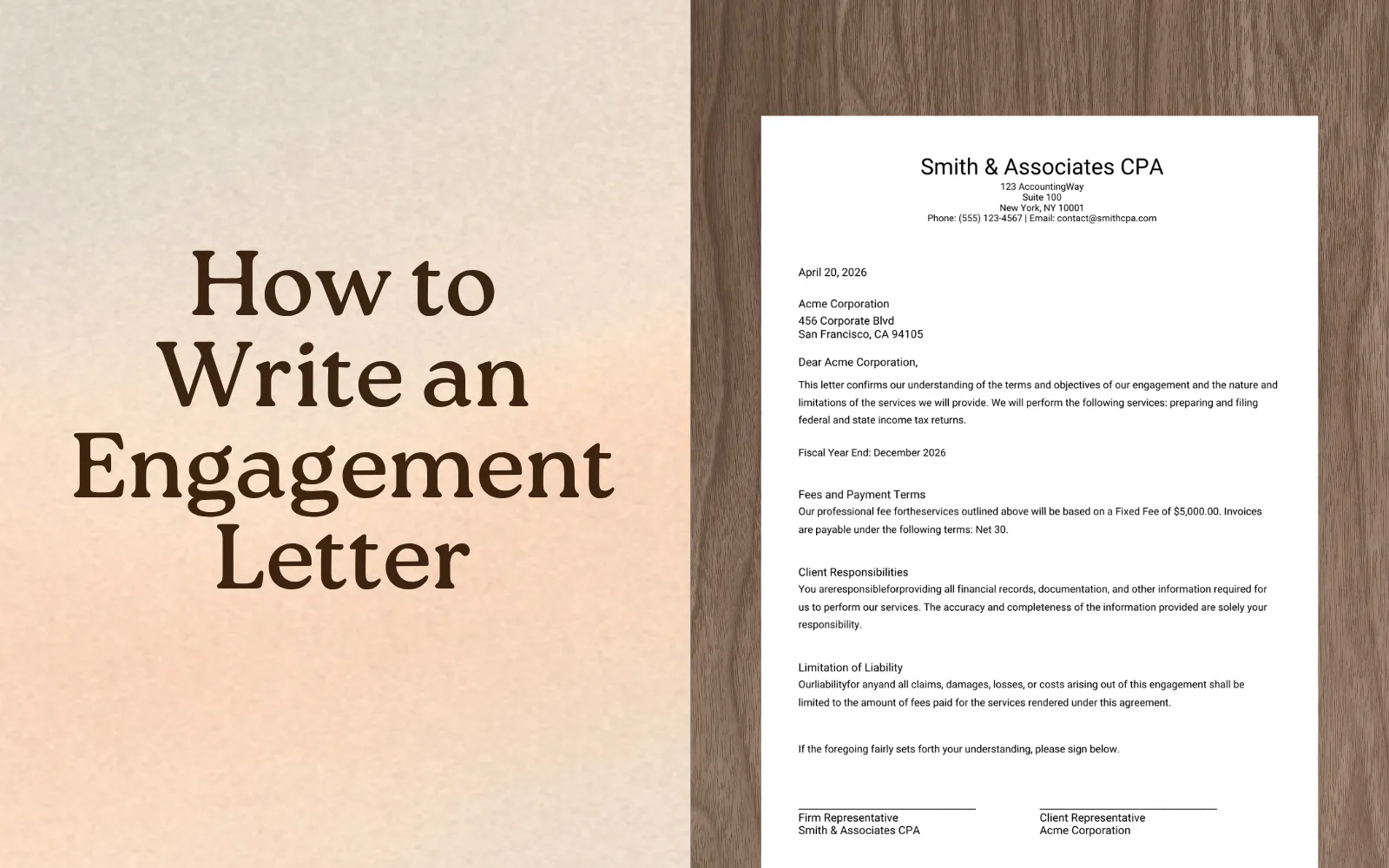
How to Write an Engagement Letter for Your Accounting Firm
An engagement letter is one of the most important documents your accounting firm will create. It defines the relationship between you and your client, sets expectations, and protects both parties legally.
Yet many firms skip it, rush through it, or use outdated templates that don't reflect their actual services.
This guide explains what engagement letters are, why they matter, and what to include. We'll also show you the fastest way to create one.
What Is an Engagement Letter?
An engagement letter is a written agreement between your accounting firm and a client that outlines the scope of work, fees, responsibilities, and limitations of your services.
It's essentially a contract that says: "Here's what we're doing for you. Here's what we're not doing. Here's what it costs. Here's what we expect from you."
Engagement letters are standard in professional accounting. They protect your firm from scope creep, misunderstandings, and liability claims.
Why Engagement Letters Matter
Liability Protection
The biggest reason to use engagement letters is liability protection. When a client signs an engagement letter, they acknowledge the scope of your work and agree to your limitations.
If a client later claims you missed something or made an error, the engagement letter becomes your defense. It shows you clearly defined what you would and wouldn't do.
Without an engagement letter, you have no documented agreement. A client can claim you promised anything, and you have no proof to contradict them.
Setting Clear Expectations
Clients often have vague ideas about what accounting services include. One client thinks "bookkeeping" means you'll handle payroll. Another thinks it means you'll file their taxes.
An engagement letter eliminates this confusion. It specifies exactly what services you're providing and what the client is responsible for.
Defining Responsibilities
Accounting work requires client cooperation. You need access to records, timely information, and accurate data. An engagement letter spells out what you need from the client and when you need it.
Establishing Fees and Payment Terms
Engagement letters document your pricing structure, payment schedule, and what happens if a client doesn't pay on time. This prevents payment disputes and ensures everyone understands the financial arrangement.
What to Include in an Engagement Letter
Every engagement letter should include these core elements:
1. Service Description
Clearly describe the specific services you're providing. Don't be vague. Instead of "accounting services," write "monthly bookkeeping, quarterly financial statements, and annual tax return preparation."
Be specific about what's included and what's not. If you're not handling payroll, say so explicitly.
2. Client Responsibilities
Outline what the client must provide and do. Examples include:
- Providing all receipts, invoices, and financial records
- Maintaining organized records throughout the year
- Responding to requests for information within a specified timeframe
- Providing accurate information about business transactions
3. Limitations of Service
Clearly state what you're NOT doing. This is critical for liability protection. Examples:
- "We will not perform a full audit unless specifically engaged to do so"
- "We will not provide legal advice"
- "We will not prepare payroll unless separately engaged"
- "We will not monitor compliance with all applicable laws and regulations"
4. Fees and Payment Terms
Document your pricing structure. Include:
- Hourly rates or fixed fees
- What's included in the fee
- When invoices are due
- Late payment penalties or interest charges
- What happens if the scope changes
5. Term and Termination
Specify how long the engagement lasts and how either party can end it. Include notice periods and any obligations upon termination.
6. Confidentiality
State that you'll maintain client confidentiality and explain any exceptions (like legal requirements to disclose information).
7. Use of Third Parties
If you use subcontractors, software providers, or other vendors, disclose this in the engagement letter. Clients should know who has access to their information.
8. Dispute Resolution
Include a clause about how disputes will be handled. Will you use mediation? Arbitration? Litigation?
Engagement Letters by Service Type
Different accounting services require different engagement letters. Here's what to emphasize for each:
Tax Preparation
For tax prep engagements, include:
- Which tax returns you're preparing (individual, business, partnership, etc.)
- Deadline for providing documents
- Your responsibility to review for accuracy
- Client responsibility to provide complete and accurate information
- Limitations (you're not performing an audit; you're relying on client-provided information)
- Fees for amendments or extensions
Bookkeeping
For bookkeeping engagements, include:
- Frequency of bookkeeping (monthly, quarterly)
- What records you'll maintain
- What the client must provide (bank statements, receipts, invoices)
- Whether you'll reconcile accounts
- Whether you'll prepare financial statements
- Client responsibility to organize records
- Fees for additional work (like corrections to prior periods)
Audit
For audit engagements, include:
- Audit scope and objectives
- That an audit is designed to provide reasonable assurance, not absolute assurance
- Limitations of audit procedures
- Auditor independence requirements
- Client responsibilities (providing access to records, explanations, confirmations)
- Timeline and deliverables
- Fees and billing arrangements
The Fastest Way to Create an Engagement Letter
Writing engagement letters from scratch is time-consuming. You need to cover all legal requirements, customize for your firm, and ensure nothing is missed.
The Engagement Letter Generator eliminates this friction. Answer a few questions about your services, fees, and firm details. The generator creates a professional, customized engagement letter in minutes.
You get a document that's legally sound, specific to your firm, and ready to send to clients. No more copying templates or hiring lawyers to review boilerplate language.
Final Thoughts
Engagement letters are not optional. They're essential protection for your firm and clarity for your clients.
Take the time to create proper engagement letters for each service type you offer. Update them annually. Have a lawyer review them if you haven't already.
Your future self will thank you when a dispute arises and your engagement letter protects your firm.