Lovable Says It Wasn’t a Data Breach. So What Actually Happened?

When AI Builders Leak (or Just “Work as Intended”): What the Lovable Situation Reveals
A situation worth paying attention to
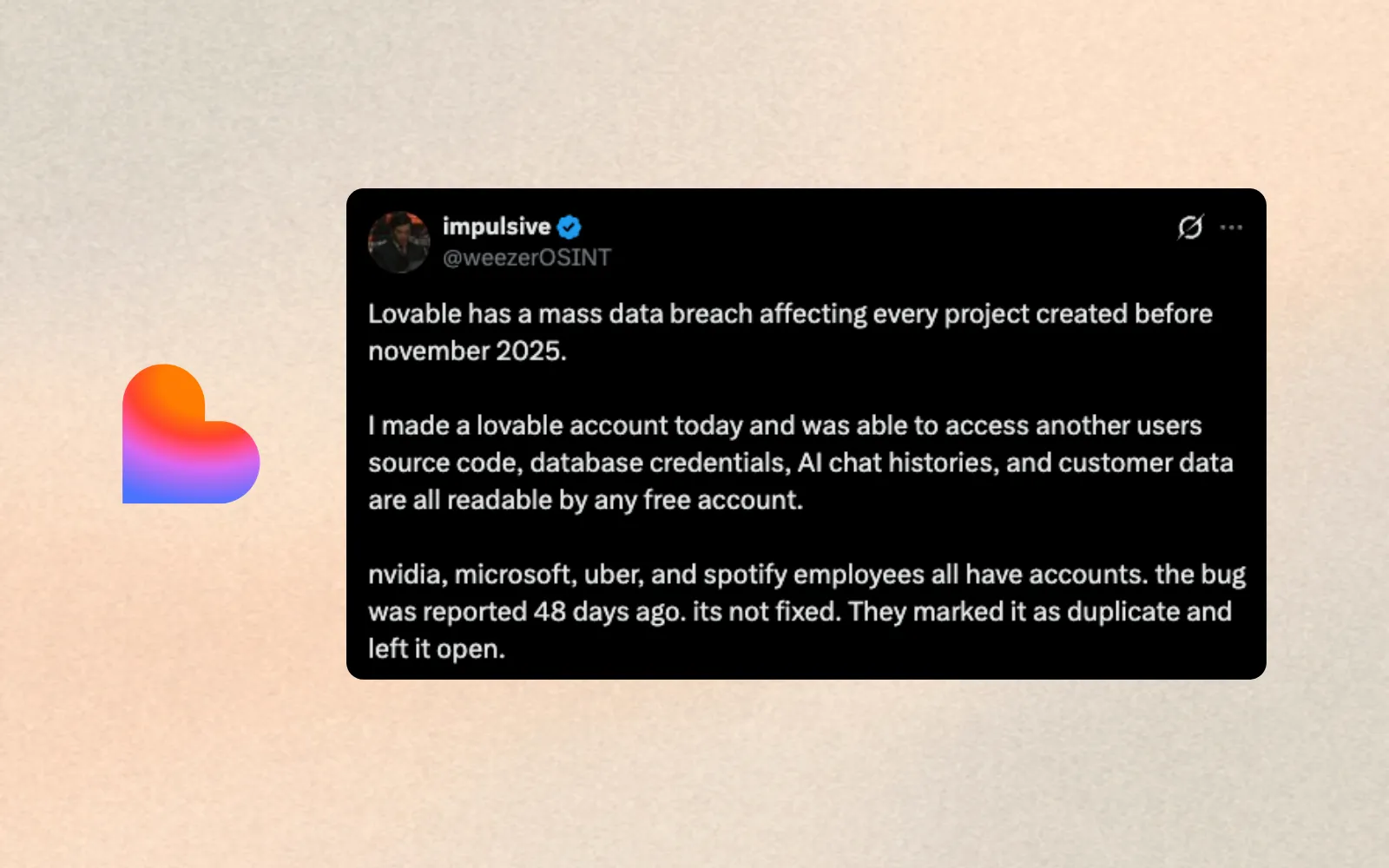
A report shared by impulsive (@weezerOSINT) raised concerns about potential exposure of project data on Lovable.
The findings suggested that, for some projects created before November 2025, it may have been possible to access:
- Source code
- Database-related information
- AI chat histories
- Other project-level data
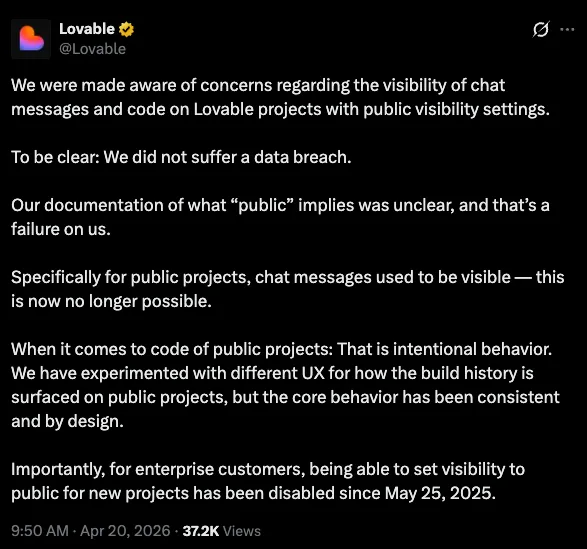
Shortly after, Lovable responded publicly (@Lovable).
Their clarification:
- They did not experience a data breach
- The issue stemmed from unclear documentation around “public” visibility
- Chat messages on public projects used to be visible, but are now restricted
- Public access to project code was intentional and by design
This is exactly why the distinction matters
Whether you call it a breach or expected behavior, the outcome for users can look very similar.
Sensitive information becomes accessible in ways they didn’t anticipate.
That’s the real issue.
Because most people building with AI tools aren’t thinking in terms of:
- “public vs private access layers”
- “API exposure behavior”
- “visibility scope of chat history”
They’re thinking:
“This is my project.”
AI builders don’t just generate code—they store context
Modern AI tools have changed how people build.
Instead of writing everything locally, users now:
- Paste credentials to debug
- Share database schemas
- Describe internal logic
- Iterate directly in chat
That means the AI system becomes more than a tool.
It becomes a central repository of context.
So when “public” includes more than expected—even if technically documented—the risk expands fast.
The uncomfortable gray area: expected vs understood
Lovable’s response highlights something important:
The behavior existed. But users may not have fully understood it.
That gap—between what a system does and what users think it does—is where most real-world issues happen.
Especially in AI products.
Because the interface feels simple, but the underlying system is not.
The hidden layer: AI conversations as infrastructure
One of the most important takeaways from the original report:
AI conversations may contain:
- Database schemas
- Migration logic
- Debug logs
- Credentials
That’s not just “chat.”
That’s infrastructure.
For many builders, the AI thread is effectively:
- their dev environment
- their documentation
- their system blueprint
If that layer is ever exposed—intentionally or not—it carries real consequences.
What this means for anyone building with AI
This moment is a good reminder to ask:
- What does “public” actually include on this platform?
- Are AI conversations treated as sensitive data?
- How are older projects handled vs newer ones?
- What assumptions am I making about privacy?
Because the defaults matter more than most people realize.
Where Floot fits into this shift
At Floot, this is something we’ve taken seriously from the beginning.
Not just in terms of security—but in terms of clarity and control.
Floot runs on a controlled, end-to-end execution stack, where:
- Project environments are isolated
- Access rules are consistent across all projects
- AI interactions are treated as part of the system, not disposable logs
- System behavior is designed to be predictable, not ambiguous
That consistency matters.
Because in a world where AI is building real products, “technically correct” isn’t enough.
Users need to actually understand what’s happening with their data.
The takeaway
This isn’t just about Lovable.
It’s about a broader shift happening right now.
We’ve moved from:
AI as a helper
to:
AI as the place where your product lives
And that shift changes everything about how these systems need to be designed.
Final thought
The biggest risk in AI products isn’t always failure.
Sometimes it’s misalignment:
Between what the system does
and what users believe it does
The tools that win long-term won’t just be powerful.
They’ll be the ones that are clear, predictable, and trustworthy by default.