Straight-Line vs Declining Balance Depreciation: Which Should You Use?

Straight-Line vs Declining Balance Depreciation: Which Should You Use?
Depreciation is how you account for the declining value of assets over time. But there are different ways to calculate it, and choosing the wrong method can distort your financial picture.
Two methods dominate: straight-line depreciation and declining balance depreciation. One spreads costs evenly. The other front-loads deductions. Understanding the difference matters for accurate accounting and tax planning.
This guide explains both methods, shows you the real numbers, and helps you choose the right approach for your business.
What Is Straight-Line Depreciation?
Straight-line depreciation divides the total depreciable value of an asset equally across its useful life. You deduct the same amount every year.
The formula is simple:
Annual Depreciation = (Asset Cost - Salvage Value) / Useful Life in Years
Example: You buy equipment for $50,000. You expect it to last 5 years and have a salvage value of $5,000.
Annual Depreciation = ($50,000 - $5,000) / 5 = $9,000 per year
Every year for 5 years, you deduct $9,000. The depreciation expense is identical regardless of when in the year you purchased the asset or how heavily you used it.
When to Use Straight-Line Depreciation
Straight-line works best for assets that maintain consistent utility over time. Buildings, furniture, and infrastructure typically hold their value proportionally.
Use straight-line if your asset's performance and value decline steadily and predictably.
What Is Declining Balance Depreciation?
Declining balance depreciation applies a fixed depreciation rate to the remaining book value of an asset each year. As the book value decreases, so does the depreciation expense.
The formula is:
Annual Depreciation = Book Value at Beginning of Year × Depreciation Rate
The depreciation rate is often double the straight-line rate, which is why this method is sometimes called "double declining balance."
Using the same $50,000 equipment example with a 5-year life:
Straight-line rate = 1 / 5 = 20% per year
Double declining balance rate = 20% × 2 = 40% per year
Now apply 40% to the remaining book value each year:
- Year 1: $50,000 × 40% = $20,000 depreciation
- Year 2: ($50,000 - $20,000) × 40% = $12,000 depreciation
- Year 3: ($30,000 - $12,000) × 40% = $7,200 depreciation
- Year 4: ($18,000 - $7,200) × 40% = $4,320 depreciation
- Year 5: ($10,800 - $4,320) × 40% = $2,592 depreciation
Notice how the annual deduction gets smaller each year. You claim larger deductions early and smaller ones later.
When to Use Declining Balance Depreciation
Declining balance works best for assets that lose value quickly in their early years. Technology, vehicles, and equipment that become obsolete rapidly fit this pattern.
Use declining balance if your asset's value drops sharply at the beginning of its life, then stabilizes.
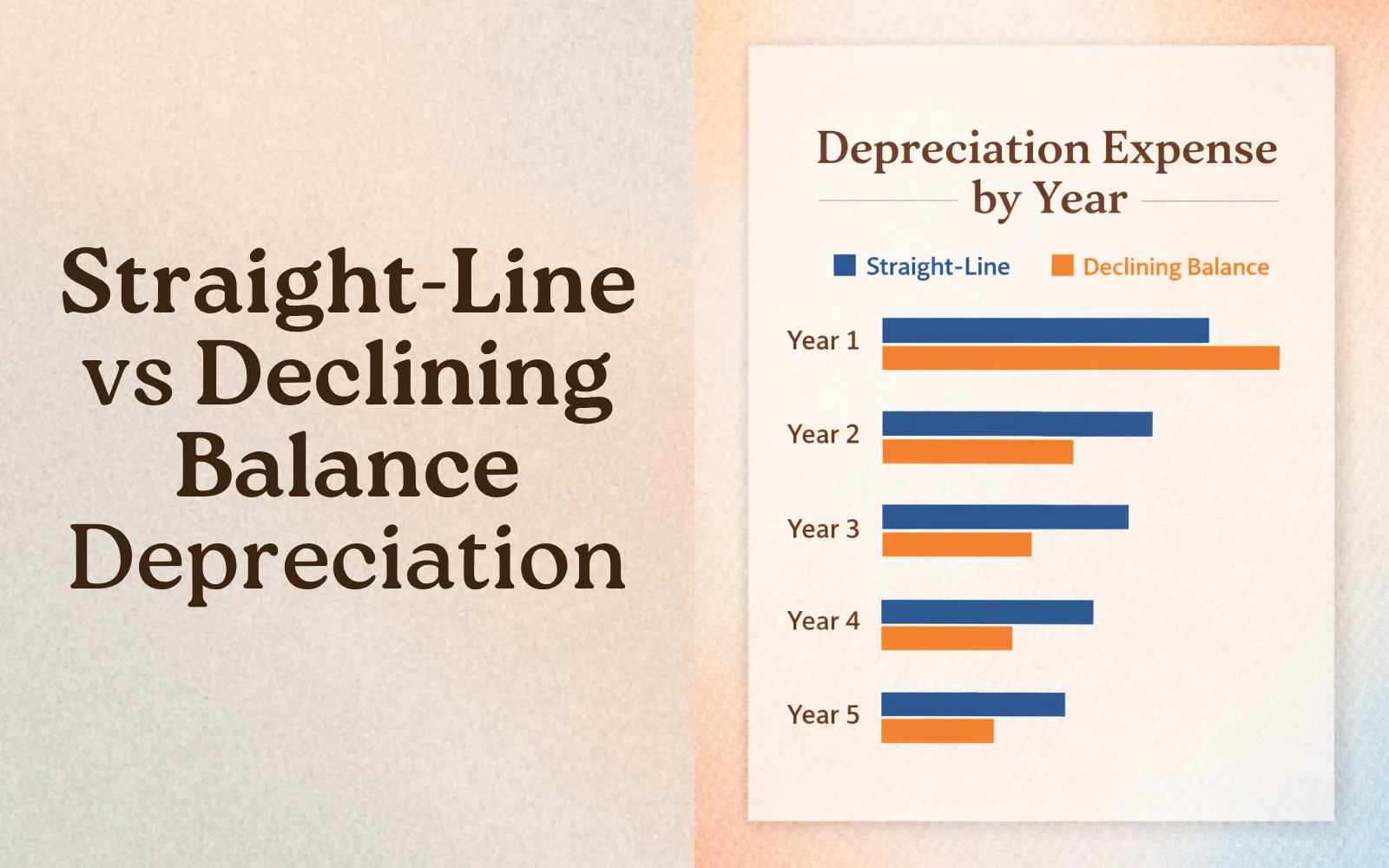
Year-by-Year Comparison: $50,000 Equipment Over 5 Years
Let's compare both methods using the same $50,000 equipment purchase with a 5-year useful life and $5,000 salvage value.
Year 1
Straight-Line Depreciation: $9,000
Declining Balance Depreciation (40%): $20,000
Difference: Declining balance deducts $11,000 more in Year 1
Year 2
Straight-Line Depreciation: $9,000
Declining Balance Depreciation (40%): $12,000
Difference: Declining balance deducts $3,000 more in Year 2
Year 3
Straight-Line Depreciation: $9,000
Declining Balance Depreciation (40%): $7,200
Difference: Straight-line deducts $1,800 more in Year 3
Year 4
Straight-Line Depreciation: $9,000
Declining Balance Depreciation (40%): $4,320
Difference: Straight-line deducts $4,680 more in Year 4
Year 5
Straight-Line Depreciation: $9,000
Declining Balance Depreciation (40%): $2,592
Difference: Straight-line deducts $6,408 more in Year 5
Total Over 5 Years
Straight-Line Total: $45,000
Declining Balance Total: $46,112
Both methods depreciate the asset substantially, but the timing of deductions differs significantly. Declining balance gives you larger tax deductions upfront.
The Key Difference: Timing of Deductions
Straight-line depreciation treats the asset loss as uniform. You get the same deduction every year.
Declining balance depreciation assumes the asset loses more value early. You get bigger deductions now and smaller ones later.
From a tax perspective, this matters. Larger deductions in early years reduce your taxable income sooner, potentially lowering your tax bill in those years.
From an accounting perspective, declining balance better reflects how many assets actually behave. A new truck loses more value in Year 1 than Year 5.
Straight-Line vs Declining Balance: When to Choose Each
Choose Straight-Line Depreciation If:
- You own real estate or buildings that hold value steadily
- Your asset's utility declines at a consistent rate
- You prefer simplicity in accounting
- You want uniform expense recognition across the asset's life
- You own furniture, fixtures, or infrastructure
- Your business prefers predictable, stable expense patterns
Choose Declining Balance Depreciation If:
- You own technology or software that becomes obsolete quickly
- You own vehicles that depreciate rapidly in early years
- You want to maximize early-year tax deductions
- Your asset loses significant value in the first few years
- You own manufacturing equipment that depreciates fast
- You want expense recognition to match actual value loss
Real-World Impact on Your Business
Choosing the wrong method can distort your financial statements and tax strategy.
If you own a $50,000 server that becomes obsolete in 3 years, straight-line depreciation spreads the loss evenly. But the server is nearly worthless after Year 2. Straight-line overstates its value in later years.
Declining balance better reflects reality. You get larger deductions when the asset is actually losing value fastest.
Conversely, if you own a $50,000 building that will be useful for 30 years, declining balance front-loads deductions for an asset that retains value steadily. Straight-line better matches the actual expense pattern.
Try Your Own Numbers
Every asset is different. The right depreciation method depends on your specific equipment, its useful life, and how quickly it actually loses value.
Use the depreciation calculator to model different scenarios with your own numbers. Enter your asset cost, useful life, and salvage value. See how straight-line and declining balance compare for your situation.
Test different asset types. Compare methods side by side. Find the approach that best reflects your business reality.
Final Verdict
Straight-line depreciation is simpler and works well for assets that hold value steadily.
Declining balance depreciation is more accurate for assets that lose value quickly and provides larger early-year tax deductions.
Most businesses use both methods. Real estate uses straight-line. Technology and vehicles use declining balance.
The key is matching the method to the asset. Choose based on how the asset actually loses value, not just for tax benefits.
Consult your accountant or tax advisor to ensure you are using the right method for each asset class in your business.