
Barber Career Map
About the project
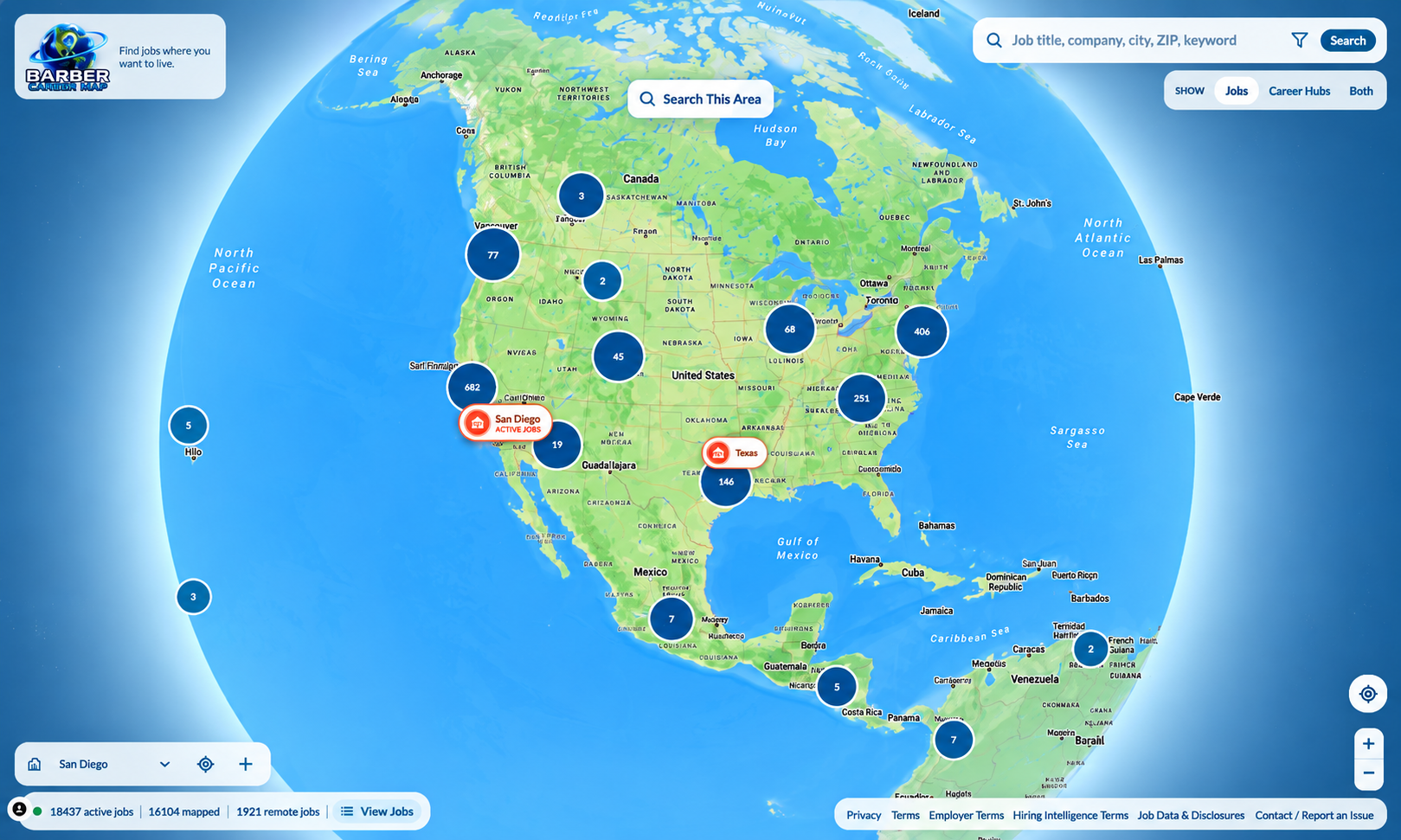
When I was considering relocating my family, I realized how disconnected job searching is from the place you actually want to live. Most job boards start with a title and provide a list of openings. I wanted to reverse that experience: start with a place, explore the map, and discover the opportunities and employers nearby. That idea became Barber Career Map, built around the belief: “Find jobs where you want to live.” Barber Career Map is a map-first job and employer discovery platform. Users can explore jobs geographically, save home locations, compare opportunities, understand commute or relocation distances, and discover employers through Career Hubs. Career Hubs are a separate discovery layer that answers a simple question: “Who can I work for if I want to live here?” They connect users to official employer career pages, even when Barber Career Map does not currently include every individual job opening. The platform also includes employer tools, job ingestion from multiple hiring systems, user profiles and personalization, analytics, and infrastructure for verified employer Career Hubs. The platform is still very early and currently in the launch and production-testing stage, so I do not have meaningful conversion numbers to share yet. Most of the early feedback has come from hands-on testing with family and people close to the project. One of the strongest reactions has been to Career Hubs: the simpler employer-discovery view can be easier to understand than browsing hundreds of individual job markers. The next stage is expanding employer and geographic coverage and putting the product in front of real job seekers. The biggest “wow” moment has been seeing how far an idea can go without starting from a traditional software-development background. Barber Career Map began as a fairly simple concept—putting jobs on a globe—but has grown into a full-stack product with live job ingestion, geographic search, user accounts, Career Hubs, employer workflows, admin tooling, analytics, payments infrastructure, and automated discovery systems. What stands out most is the speed of iteration. I can test something in the real product, find a problem or have a new idea, change the architecture, and immediately see it become part of the application. Watching the map grow from a concept into hundreds of real employer discovery points across the country was probably the moment it started feeling like an actual platform rather than just a project.