Koala WFM
프로젝트 소개
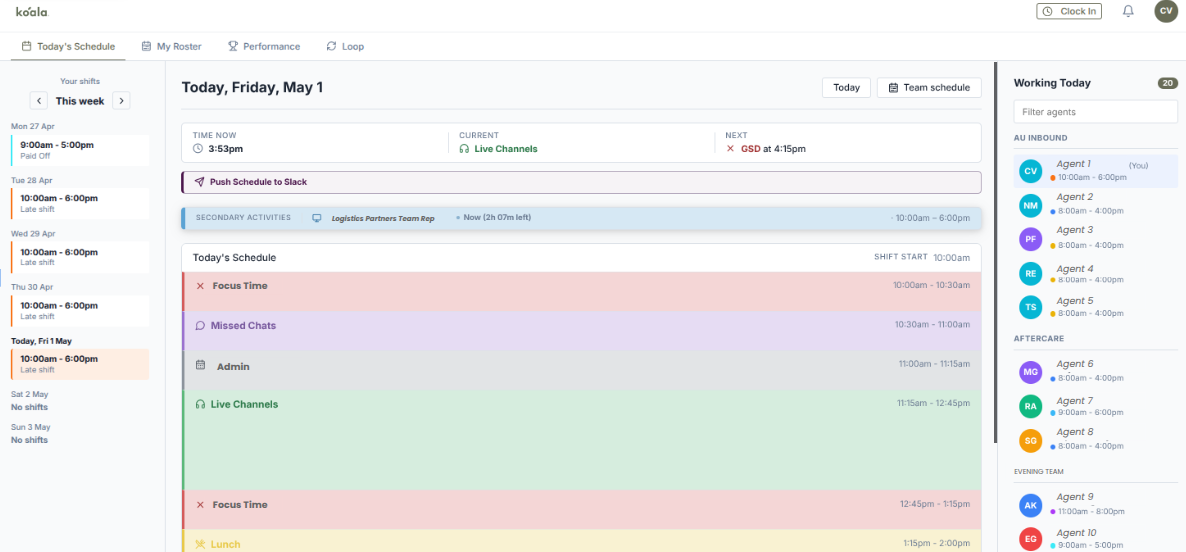
Our journey began with a simple goal: to replace an expensive and underwhelming Workforce Management (WFM) subscription that wasn't delivering enough value. We believed we could create the core rostering and activity scheduling component for our Contact Center ourselves – and we did, quicker than we anticipated. As we wrapped up that initial task, we found ourselves only scratching the surface of what we could achieve by owning the entire stack. So, we pushed further. We added features like organizational structure visualization, FTE tracking across internal and BPO teams, attrition modeling, AI deflection analytics, and performance dashboards. These were tools that typical enterprise providers either reserve for higher tiers or fail to customize for unique operational needs. What started as a cost-cutting initiative evolved into a robust solution that now consistently outperforms our previous tools, boasting forecast accuracy of over 95%. Our platform is a workforce management solution designed specifically for contemporary customer service teams utilizing a blend of internal agents, BPO partners, and AI deflection. It features a live organizational chart that monitors every agent's FTE, role, team lead relationship, resignation timeline, and BPO status, all integrated with scheduling, volume forecasting, and performance analytics. But it doesn't stop at operational insights. Our built-in coaching tools use actual agent performance data to guide structured bi-weekly coaching sessions, empowering team leaders to base their discussions on real metrics rather than intuition or memory. Unlike many enterprise WFM tools that market forecast accuracy above 95% as a selling point, we consistently achieve or surpass this figure by utilizing a model tailored to our unique data structure. The end product is a platform that seamlessly manages staffing, nurtures talent, and provides reliable reporting you can trust, eliminating the need for sanity checks. Although the platform is currently internal-only, the feedback from our team has been overwhelmingly positive. Team leaders were immediately impressed, especially with the custom-built features like Quick Rostering and Quick Plans. Quick Plans doesn't only account for live contact coverage; it also considers secondary activities that agents manage throughout their day, which most WFM tools typically overlook, categorizing them as 'non-productive time.' Our Slack integration has also been a big hit, automating activity change reminders during shifts and automatically handling clock-ins when agents log in. For our fully remote team, this has revolutionized how we track schedule adherence, removing manual tracking and ensuring accurate data flow without requiring constant follow-ups or additional spreadsheets. One of the most remarkable moments during the development on Floot has been how intuitively it follows instructions. Creating a WFM platform with complex scheduling rules, FTE calculations, hierarchy structures, Slack integrations, and adherence tracking, I expected significant revision cycles and constant back-and-forth communication. Surprisingly, we encountered very few issues. The platform understood our needs and executed them accurately, almost every time. This experience felt less like typical tool usage and more like collaboration with a product engineer who grasped our requirements in real-time and delivered on them. This transition from 'prompting an AI' to 'collaborating with someone who understands' was a turning point, revealing that we weren’t just building faster; we were fundamentally changing the construction process itself.